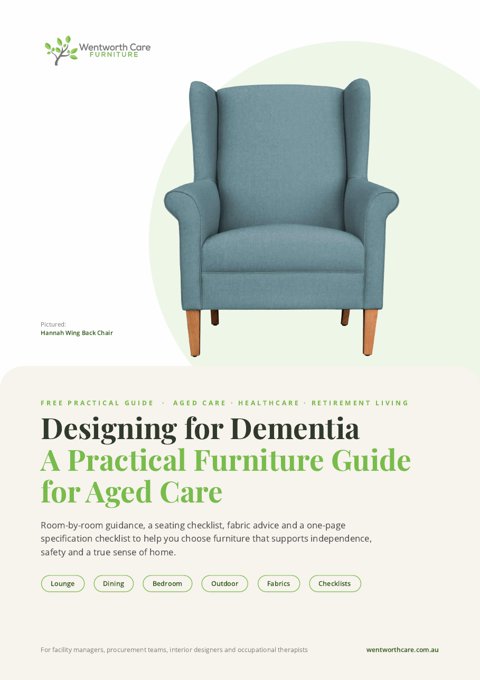
Dementia-friendly furniture is furniture that helps a person living with dementia stay independent, safe and at home in their surroundings. In practice that means stable chairs with arms for safe sit-to-stand, seat heights of around 480–520 mm, clear colour contrast between the seat, arms and floor, rounded edges, and fabrics that look residential but survive hospital-grade cleaning.
This guide brings together everything Wentworth Care Furniture has learned from more than 20 years of fitting out Australian aged care homes and specialist dementia units: the national design principles, what to look for room by room, the specifications and standards that matter, and a checklist you can take into your next procurement brief.
In this guide:
For people living with dementia, familiar surroundings can reduce anxiety and provide reassurance. A 2018 review of the research published in The Gerontologist linked home-like environments in long-term care with lower levels of aggression, agitation and anxiety. Government funding such as the Specialist Dementia Care Program reflects the same recognition: clinical care is essential, but the spaces people live in every day have a real effect on their comfort, confidence and quality of life.
Furniture sits at the centre of that. It is what residents touch, sit on, lean on and navigate around all day.
Australia now has national guidance for residential aged care design: the National Aged Care Design Principles and Guidelines (June 2024), developed with Dementia Training Australia. They are not a product standard, but they are government-endorsed guidance that shapes design briefs and procurement. The four principles are:
State guidance, such as the Victorian Department of Health’s dementia-friendly environments resources, applies these ideas to furniture specifically. Dementia-friendly furniture should be:
Seating is where dementia-friendly design matters most, because getting in and out of a chair is one of the most frequent and highest-risk movements in a resident’s day.
Armrests provide the leverage and feedback needed for a safer sit-to-stand, especially where balance, motor planning and strength are affected by dementia. Look for arms that extend far enough forward to push up from, and that are stable enough to take a resident’s full weight when they lean on one side.
Retail lounge chairs often sit at 430–460 mm, which is too low for older adults and increases both effort and falls risk. Access guidance allows the preferred seat height to be raised to 520 mm where many users are elderly. Wentworth typically targets 480–520 mm, so feet plant flat on the floor, hips stay level with or above the knees, and standing is easier.
Australian aged care research found many lounge chairs were too deep for older women, with depths of 480–530 mm observed against a recommended 440 mm. A seat that is too deep pushes residents into a slumped posture and makes it harder to shuffle forward to stand. Wentworth specifies lounge chairs to aged care proportions, with shallower seat-depth options of around 440–460 mm, and a firm surface rather than one residents sink into.
Rocking chairs have remained popular in dementia care for good reason. A University of Rochester study of nursing home residents with dementia (Watson, Wells and Cox, 1998) found that regular rocking reduced anxiety and depression, eased pain and improved balance. Residents rocked for between 30 minutes and 2.5 hours a day, five days a week. Among those who rocked for more than 80 minutes a day, crying and expressions of anxiety, tension and depression fell by up to a third, and the residents who rocked most asked for pain medication less often.
Rocking chairs are best suited to people in the early to middle stages of dementia and are generally not recommended for people with advanced dementia. A purpose-built aged care rocker should have a stable base, supportive arms and a high seat for easier transfers. Read more about the therapeutic benefits of rocking chairs for people with dementia, or see the Australian-made Roki rocking chair.
In shared lounges, dementia units and higher-acuity areas, upholstery has to withstand frequent disinfection and body-fluid clean-ups. Retail textiles often pill, stain or break down under hospital-grade cleaning, and rarely come with the documentation aged care providers need.
The aim is to balance dignity and a residential look with practical housekeeping. Furniture should never look clinical simply because it serves a functional purpose.
There is no single “Australian Standard for dementia furniture”. Instead, providers usually build their specification from three sources:
Stable frames and anti-tilt geometry matter as much as certificates. A chair needs to resist tipping when a resident leans heavily on one arm to stand.
Lounges should encourage conversation and calm. Arrange supportive armchairs and sofas in small, domestic-style groups rather than in rows or at right angles, leave clear wheelchair paths, and use warm, soft fabrics. A rocking chair or a distinctive piece of furniture can double as a landmark that helps residents recognise the room. Explore our aged care lounge furniture and armchairs.
Dining rooms work best when they feel like a family kitchen rather than a canteen. Dining chairs should have arms that slide under the table, which supports a safe eating posture and reduces spills, along with a 480–520 mm seat height, skid-resistant glides and an easy-clean seat. Tables need to accommodate wheelchairs and give each person enough room to focus on their own meal. Read why dining chairs with arms are a good idea for older people and why more homes are choosing dining chairs with front castors, or browse our aged care dining furniture.
Bedrooms should be furnished with warmth and dignity and feel like the resident’s own room. That means high-quality beds at the right height, home-like bedheads, space for personal furniture and belongings, and a stable tub chair or armchair with arms. Non-glare fabrics and contrasting piping help define the edges of seating. For residents at risk of falls from bed, see lo-lo and floorline beds explained and our hi-lo and lo-lo beds, or explore the full aged care bedroom furniture range.
Access to outdoor spaces has long been recognised as an important part of dementia care. Time with nature, such as the scent of rosemary, the feel of soil or simply watering a plant, can reduce agitation, spark memories and lift mood. Gardening also offers gentle exercise, sensory stimulation, social connection and the satisfaction of growing something.
Traditional garden beds are a falls risk for residents who are unsteady on their feet, and they shut out anyone who can’t bend, kneel or stand for long periods. Wheelchair-accessible wicking planter boxes let residents garden comfortably from a chair or wheelchair, and their self-watering systems keep maintenance low for lifestyle and grounds teams. Just as importantly, a garden gives people a responsibility and a renewed sense of purpose: there are seedlings to nurture and herbs to harvest for the kitchen. Read what happens to our sense of purpose when everything is done for us, or explore our wheelchair-accessible wicking planter boxes.
Use this as a quick reference when comparing products or writing a brief.
| Item | Look for |
|---|---|
| Dining chairs | Arms that fit under the table; 480–520 mm seat height; skid-resistant glides; textured or vinyl seat; AS/NZS 4688 strength and stability |
| Lounge chairs | Armrests extending forward for push-up; shallower seat depth (around 440–460 mm); firm, not sink-in, cushioning; wipe-clean fabric or vinyl |
| Bedroom seating | Stable tub chair or armchair with arms; non-glare fabric; contrasting piping for edge definition |
| Beds | Height suited to the resident (hi-lo or lo-lo where falls risk is high); home-like bedhead |
| Fabrics | Bleach-cleanable or antimicrobial; AS/NZS 1530.3 fire documentation; high abrasion rating; moisture barrier; zipped or replaceable cushions |
| Visual design | Clear contrast between seat, arms and floor; plain or softly textured, low-glare fabrics; residential, not clinical, styling |
| Safety details | Rounded edges; wall-saver frames; anti-tilt geometry; stable under a heavy lean on one arm |
| Outdoors | Wheelchair-accessible, seated-height planter boxes; self-watering wicking system; clear paths and garden destinations |
Want the full version? Download our free guide, Designing for Dementia: A Practical Furniture Guide for Aged Care, with room-by-room guidance, a seating checklist, fabric advice and a one-page specification checklist.
Upgrades are inevitable, but for people living with dementia a change to their surroundings can be disorienting. The goal is to finish the project with an environment that still feels familiar and home-like, which takes careful planning with designers who understand dementia.
No two aged care homes are the same. Resident needs, available space, care models and budgets all vary, so furniture selection should never be one-size-fits-all. See more of our aged care furniture projects.
Whether you’re refurbishing an existing home, fitting out a new one or planning a specialist dementia unit, we can help with practical advice and furniture that combines durability, comfort and residential style, along with fire and strength documentation for your files. Call 03 9408 9710, email info@wentworthcare.com.au or contact us online.
Dementia-friendly furniture is stable, supportive and free of sharp edges, with chair arms for safe sit-to-stand, a seat height of around 480–520 mm, clear visual contrast for depth perception, low-glare and easy-clean fabrics, and a home-like rather than clinical look.
No single standard covers “dementia furniture”. Providers commonly require commercial-grade strength and stability (for example AFRDI certification to AS/NZS 4688) and documented fabric fire performance to AS/NZS 1530.3, guided by the National Aged Care Design Principles and Guidelines (2024).
Around 480–520 mm. This keeps the hips level with or above the knees so residents can stand with less effort. Typical retail chairs sit lower, at 430–460 mm.
Retail furniture is usually too low, too deep and not built for hospital-grade cleaning or commercial loads. It rarely carries fire or strength documentation, and often lacks the arms, contrast and stability that support people living with dementia.
For people in the early to middle stages, yes. University of Rochester research found regular rocking reduced anxiety, depression and pain and improved balance. Rocking chairs are generally not recommended for people with advanced dementia, and a trial is the best way to check suitability for an individual.
Gardens offer gentle exercise, sensory stimulation, social connection and a sense of purpose. Wheelchair-accessible planter boxes let residents garden safely while seated, reducing falls risk and opening gardening up to residents of all mobility levels.
© 2026 Wentworth Care Furniture | Website by Bsharptech
The holiday season fills up fast. Get in touch now and our team will help you plan delivery before the Christmas break. Fill out the form below or call 03 9408 9710. You can also browse furniture available pre-Christmas.