
When people first see how low our beds go, the most common question is simply: “Why?”
The short answer is falls. Falls — and especially falls from bed — have become a major safety issue in aged care, particularly since facilities have moved away from using safety rails. A resident who falls out of bed can suffer serious injury, and the higher the bed, the worse that fall tends to be.
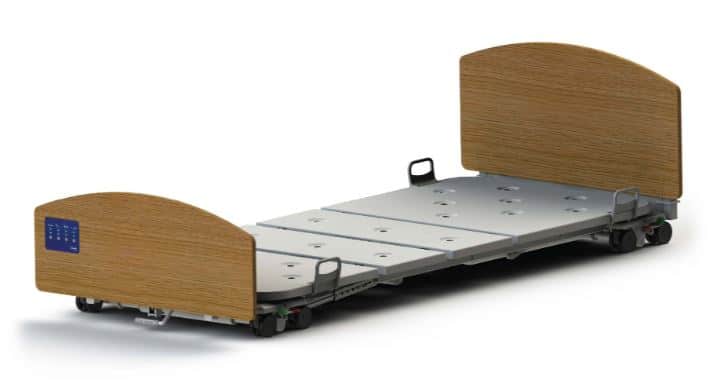
By lowering the bed to its lowest position — close to the floor — the distance a person can fall is dramatically reduced, and so is the risk of injury. These low beds are usually called Lo-Lo beds (also known as floor beds or floorline beds). In their lowest setting they sit just above the floor, which is why they’ve become so popular in aged care and dementia settings.
Crucially, a Lo-Lo bed doesn’t only go low. Like a standard Hi-Lo (hospital) bed, it also raises to a comfortable working height when a carer needs to provide care, then lowers again for the resident’s safety. So you get the safety of a low bed and the practicality of an adjustable one.
“Low” covers a wide range, so it is worth looking at real numbers. A standard Hi-Lo bed bottoms out around 285mm. A Lo-Lo bed goes considerably lower — our lowest sits at 120mm, roughly the height of a house brick laid flat.
| Bed | Lowest height | Highest height | Safe working load |
|---|---|---|---|
| EN7 Lo-Lo | 120mm | 720mm | 200kg or 300kg |
| CS8 Lo-Lo | 150mm | 680mm | 250kg |
| EN9 Lo-Lo | 170mm | 725mm | 250kg |
| Malibu Hi-Lo | 285mm | 685mm | — |
Two things are worth drawing out of that table.
First, the difference between a Hi-Lo and a Lo-Lo at the bottom of their range is about 165mm. That sounds minor written down, but it is the difference between a fall from mid-shin height and a fall from just above the floor, and it is the whole reason Lo-Lo beds exist.
Second, every bed in the range still rises to roughly 680-725mm. A Lo-Lo bed is not a mattress on the floor. It goes lower than a hospital bed for sleeping and higher than most for care, which is what makes it practical for staff as well as safer for the resident.
If you are weighing a Lo-Lo against a Hi-Lo, the question is usually not which is better but whether that particular resident’s falls risk justifies the lower sleeping height. An occupational therapist can advise on the individual assessment.
Low beds are especially suited to:
Crash mats are often used alongside low beds. A crash mat is a cushioned mat (essentially a mattress on the floor) placed beside the bed, so that if a resident does roll or slip out, they land on a soft surface — further reducing the risk of injury. Some setups also pair the bed or mat with a fall alarm to alert staff.
Safety rails were traditionally used to stop people rolling out of bed. But over time it became clear they carried their own risks: some residents would try to climb over them and fall from an even greater height, and rails are increasingly viewed as a form of restraint. Lowering the bed instead manages the same risk — without restraining the resident — which is why low and floorline beds have become a preferred approach.
Going low is about safety at night, but daytime usability still matters. Because Lo-Lo beds raise as well as lower, the resident (or their carer) can set a comfortable height for getting in and out, then drop the bed low again for sleeping. It’s worth discussing the right setup with your occupational therapist or care provider.
See our range of Hi-Lo and Lo-Lo beds: Hi-Lo and Lo-Lo beds. Or browse all aged care bedroom furniture: aged care bedroom furniture. To talk through the right bed for a resident or loved one, call 03 9408 9710 or email info@wentworthcare.com.au.
To reduce injury if a resident falls out of bed. The lower the bed, the shorter the fall — which is especially important now that safety rails are used far less. These low beds are called Lo-Lo or floorline beds.
Our Lo-Lo beds start as low as 120mm from the floor, compared with around 285mm for a standard Hi-Lo bed. Each model still raises to roughly 680-725mm so carers can work at a comfortable height. The exact range depends on the bed — the EN7 covers 120-720mm, the CS8 150-680mm and the EN9 170-725mm.
A bed that lowers much closer to the floor than a standard hospital bed, while still raising to a comfortable height for care. It’s used to reduce fall injuries, particularly for residents with dementia or a high falls risk.
For many residents, yes. Bed rails can lead to injuries when people climb over them, and are increasingly considered a restraint. Lowering the bed manages falls risk without restraining the resident, which is why many facilities now prefer low beds.
A crash mat is a cushioned mat placed beside a low bed so that if a resident rolls or slips out, they land on a soft surface. It’s a common, simple way to further reduce fall-related injuries.
Residents at high risk of falling from bed, people living with dementia, those who are agitated or restless, and anyone for whom bed rails aren’t suitable.

© 2026 Wentworth Care Furniture | Website by Bsharptech
The holiday season fills up fast. Get in touch now and our team will help you plan delivery before the Christmas break. Fill out the form below or call 03 9408 9710. You can also browse furniture available pre-Christmas.